An Interview with Emma Plotkin

a29010d0-265d-48ef-98f0-621cef62eec9

Emma Plotkin discusses her new play PINA, which will be premiering as part of the 365 Women a Year Festival at Hubbard Hall’s Winter Carnival.

Interviewer: Natalie Osborne

Q: How did you hear about 365 Women a Year?

A: I first heard about 365 Women a Year when I saw the festival performed at Bennington College.

Q: Why did you choose Pina Bausch as your historical woman? What drew you to her?

A: Pina is one of the foremost choreographers in modern dance. Her work is raw and revolutionary. It contains a clear love of lines and creates pictures on stage but there is also a theatrical element that doesn’t seem overwrought or cliched. I love the way she speaks about dance, it is clear that this art is her innermost being.

Q; Can you walk me through the process of adapting a person’s life for the stage? What were some of the challenges? Which parts really clicked together?

A: I have seen a couple of documentaries about Pina before beginning the process of adapting her life, including “Pina” by Wim Wenders and “Dreams in Motion: In the Footsteps of Pina Bausch.” I also watched some of her most acclaimed work including “Cafe Muller” and “The Right of Spring.” After this I sorted through some interviews to get a better sense of how Pina speaks, not only the content but the speech pattern. It was difficult to find articles Pina had written but there is one speech she wrote for the Kyoto Prize in 2007 called “What Moves Me” that helped fuel this play. Some things are directly sourced from this speech, for example the phrase “What moves you?” and the story about Pina living in the restaurant with her father. I knew that the story could not possibly be a completely accurate portrait of Pina and her company, but all the dancers are based on real people.

There is very little documentation about Pina’s personal life save that her first husband had passed and that she remarried and had a son. The entire “personal life” section on her Wikipedia page took up two sentences! Pina is not a love object; that is not why I and other people should look up to her. Pina’s life was in her work. So I wanted to write a piece that provided commentary to her choreography and an emotional dialogue embedded in the practicalities of creating work. When Josephine says that “Cafe Muller” is revolutionary she means it. “Cafe Muller” comes out of Tanztheater Wuppertal, dance theatre, a form with music and other sounds, strong emotions and evocative set and costume. Pina says “It is almost unimportant whether a work finds an understanding audience. One has to do it because one believes that it is the right thing to do. We are not only here to please, we cannot help challenging the spectator.”

Q: Can you walk me through how you incorporated movement into the piece?

A: Pina is all about movement. If you watch her interviews and read her speeches there is a certain way they move too, everything blends together, which is the basis of Tanztheater Wuppertal.  So I would write with music from her show in the background and then watch and rewatch her dances. The dance I was most drawn to was “Cafe Muller.” I remember seeing this dance on Youtube when I was a child and not understanding in my mind but responding deeply to the movement that seemed so longing, desperate and lonely. After reading Pina’s story about her childhood in her father’s restaurant, I arrived at a possible conclusion for the choreography behind this piece. The movement motivates the dialogue, it recalls the past.

Q: Are there any playwrights that inspired you while you were working on the piece, or who inspire you in general?

Yes, I was reading well over a dozen plays (at the same time ahh!) before starting this piece and while the styles may be different, I have a lot of a playwrights who have influenced or inspired my writing. I owe a great debt to Lanford Wilson, not only as a playwright but as a teacher. When I was 17 I attended a program called New York Summer School for the Arts of (NYSSSA). This is where I learned how to work with an ensemble, to move between dance and theater and this is where I wrote one of my first plays. Lanford Wilson had fought and fundraised for NYSSSA and the program continues to benefit from his patronship. I assistant directed two short Tennessee Williams plays last year at the Hangar Theatre. Tennessee Williams is one of the foremost poet playwrights of our time. Poetry to movement is like sand to the sea, enriched by their joining. Sherry Kramer, a playwright responsible for such transformative work as “The Bay of Fundy” has been a huge inspiration. Not only is she a terrific playwright but she is an incredible teacher at my school. Sherry has taught me the ABC’s of playwriting, everything from breaking down a script to breathing life into my characters. I owe her a great debt and am forever grateful for her support and knowledge. Other playwrights that have had a profound influence on my work include Sarah Ruhl, Sarah Kane, Alice Birch, Caryl Churchill, Anton Chekhov, William Shakespeare and Sophocles.

Q: What has been your favorite aspect of working with 365 Women a Year?

I love that this festival feels like a community! I saw 365 Women a Year Bennington College. I met the inspirational powerhouse Shelly Lubin and I’ve been fortunate to study with Natalie Osborne! Part of my studies include female empowerment and examining female role models in media, so this was an amazing opportunity to put a woman on stage who is complicated, dynamic and focused on following her passions rather than focusing on a love interest or being flattened by passivity and circumstance. Pina is powerful. Pina is revolutionary. Pina is an inspirational woman!

Q: Do you have any advice for playwrights joining 365 Women a Year in 2016?

Take your time selecting a woman to write about. I spent a couple of weeks looking through autobiographies and watching movies before I chose Pina. Also ask yourself, “What about this woman inspires me?” Personally I would stay away from her love life unless it’s relevant to what makes her kick ass, because putting a woman on stage is not enough. As a playwright we have a responsibility to put up characters who are holistic (or satirically flat), who have passions and who inspire others to live empowered fulfilling lives which are not going to be derived solely out of the media myth of romantic love! Am I for love, hell ya! Do I love my work, hell ya! Do I love my family, hell ya! So let your character love, but love the world, let her be so big and complicated and powerful and fearful and loving that she becomes a hand pressing at the ceiling – confines that each of us has placed on ourselves. Write a woman who shatters the ceiling, that’s the play I want to see.

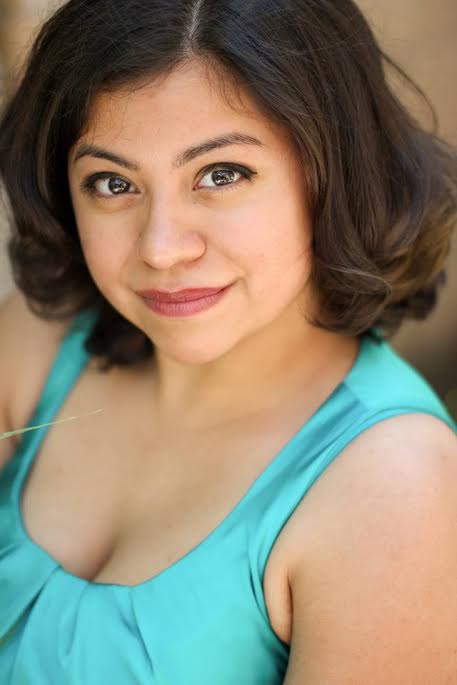
Emma Plotkin is a Playwright/Poet, Director/Devisor, Actor, Singer/Musician, Mover/Dancer (Theater Maker?) and Life Lover from Ithaca NY. At Bennington College she explores the interdisciplinary nature of performative work as well as themes of marginalization and empowerment including the history of colonialism, structural and microaggression, feminism, gender equality, global conflict resolution and the portrayal of figures in media. At the heart, her work has explored the humanness of characters colliding with rigid societies. Her most recent work includes devising/directing “One Man” which investigates assimilation and incarceration in a hierarchical world (sounds familiar) and directing/writing “Black Out” which explores the relationship of a dying Jewish woman and her former Nazi pupil during the beginning of WWII. Emma has most recently studied with and owes a great debt to, Robert Wilson and the Watermill Center, Sherry Kramer, Dina Janis, Jean Randich and the whole of Bennington College, Teya Sugareva, The Hangar Theatre, New York State Summer School of the Arts and Running to Places Theatre Company as well as her incredible friends and family. There is no way I would be here today without your mentorship, love and support.

An Interview with Shellen Lubin (Reposted)

We’re very excited to have the opportunity to develop 365 Women a Year, The Bennington plays, further with Hubbard Hall as part of their Winter Carnival.

In preparation for the performance, we’re reposting this interview with Shellen Lubin regarding her play After the Thin Man. This interview was originally published on the site in 2015.

You can see After the Thin Man, and the other 365 Women a Year plays, on Friday, January 29th and Saturday, January 30th at 8pm.

10486376_10153092201196564_1097019723351688474_n

Interviewer: Natalie Osborne

Q: How did you hear about 365 Women a Year?

A: On facebook — not even sure whether it was a post in the Playwriting group there — or just noticing one of Jessica’s posts — but I immediately became involved.

Q: Why did you choose Stella Adler and Sylvia Gassell as your historic women? What drew you to them?

A: I studied with Stella Adler when I was younger, and she was in her 70s. Sylvia Gassell was in a play of mine when she was in her late 60s. Sylvia told me about Stella coming back from Hollywood and telling her not to go out there as a “character actress” because there are no parts for them. It’s something that has stayed with me all these years. I decided to imagine the moment when Stella gave up on acting as a profession and decided to teach, and that decision became the center of this play. (Also the fact that she was right, because, as brilliant as Sylvia was, how much did she really get to work in New York?)

Q: Can you walk me through the process of adapting a persons life for the stage? What were some of the challenges? What parts really clicked together?

A: I read and read until something about their path excited me, sparked me, and then focused my research on that aspect, fleshing out “information” where I needed it. The biggest challenges are 1) knowing that truth is more important than life, and so you have to write what makes the play work, not worry about what actually “happened”; 2) knowing that whatever you write about them, there is so much more, and the more ground you try to cover the less depth the piece will have.

The clicks were mostly found in the writing itself, the discoveries that come up when you create characters in your mind and set up the scene and discover where it goes. Some of the greatest clicks were: when I discovered why Stella became a teacher, something that she never discussed publicly and I’ve never heard anyone say about her, but I’m sure is true; when I discovered why she set up her classroom the way she did, not just to aggrandize herself.

Q: Are there any playwrights that inspired you while you were working on this piece, or who inspire you in general?

A: Lanford Wilson. Secrets. Discoveries. August Wilson. Athol Fugard. And Shakespeare. Keeping things active.

Q: What has been your favorite aspect of working with 365 Women a Year?

A: I have only once before written a biographical piece, and working on this piece has really helped me with that one (still in the middle of re-writes). I have also only written a few short plays. Most of my work has been full-length. It has been very exciting to just pick women I want to write about and then read all about them, become absorbed in their lives, and discover what it is I want to say, the angle I want to come from, how I want to say it.

Q: Do you have any advice for the playwrights joining 365 Women a Year in 2015?

A: Don’t think you have to decide what you want to write about the person first. Go deep into them and find where they touch you deepest.

And don’t try to cover too much ground. The illumination of one moment or a sequence of a few moments is actually much more interesting than a bio-pic (as it were) of their lives. It’s not a history lesson. It’s a play.

Shellen Lubin is a playwright, songwriter, and director, most recently writing music & lyrics for Susan Merson’s BETWEEN PRETTY PLACES and THE QUALITY OF RESPECT, her take on Shakespeare’s Merchant of Venice. Other produced plays include: IMPERFECT FLOWERS, WAITING, COFFEE ONCE A YEAR, ELEVATOR INVENTIONS. Musicals include: MOLLY’S DAUGHTERS, MY BRAVE FACE, and DEAR ALEX, DEAR HARRIET. She is currently working on the musical WHAT ZEESIE SAW ON DELANCEY STREET (with Elsa Rael and Matthew Gandolfo) and THE SARAH PROJECT. Co-President – Women in the Arts & Media Coalition; Co-Secretary – League of Professional Theatre Women; DG, BMI, SDC, AEA @shlubin @MonMornQuote.

A Year in NOplays

SDC11134

2015 was a huge year for NOplays!

365 Women a Year Poster small Update

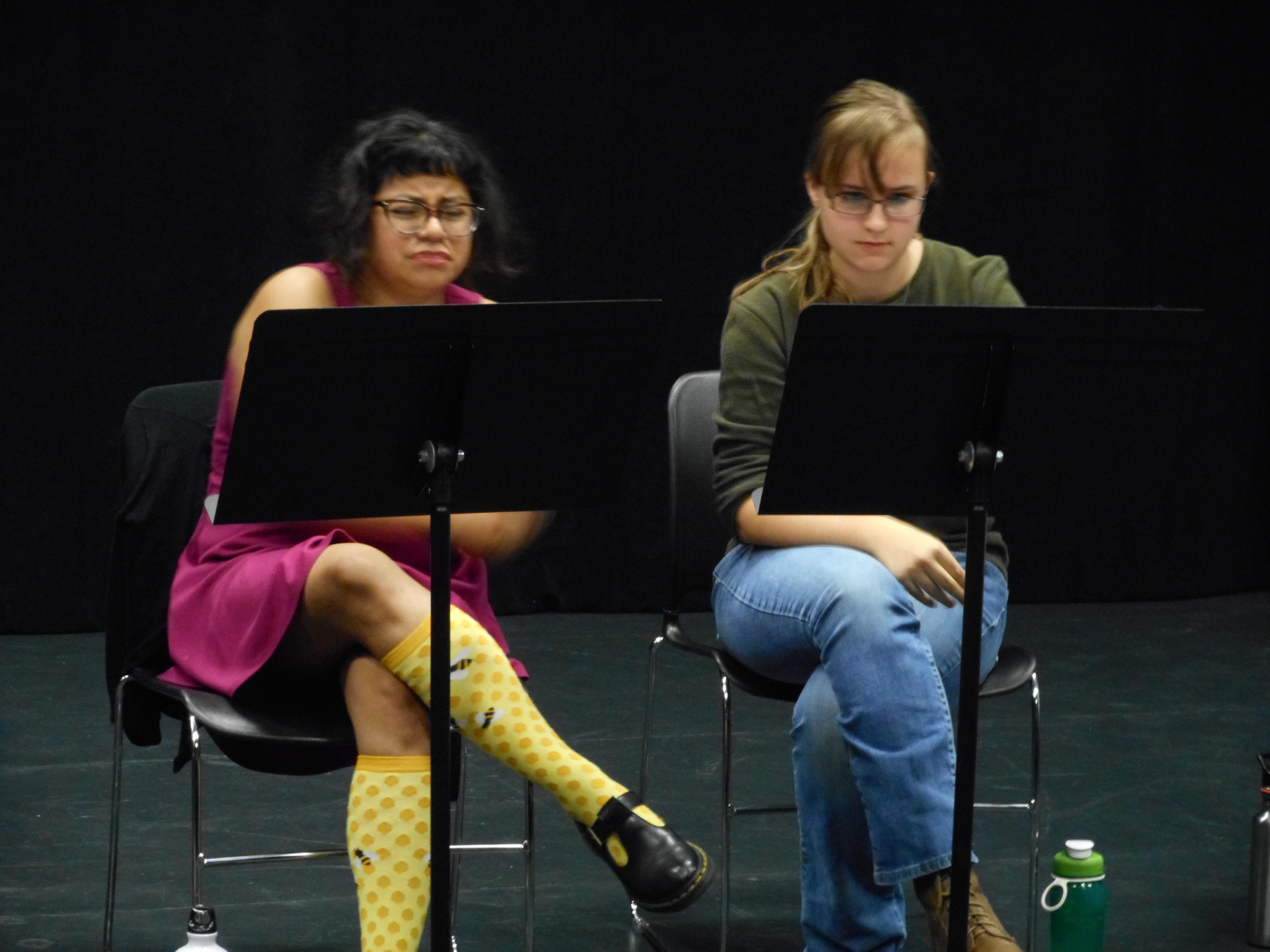
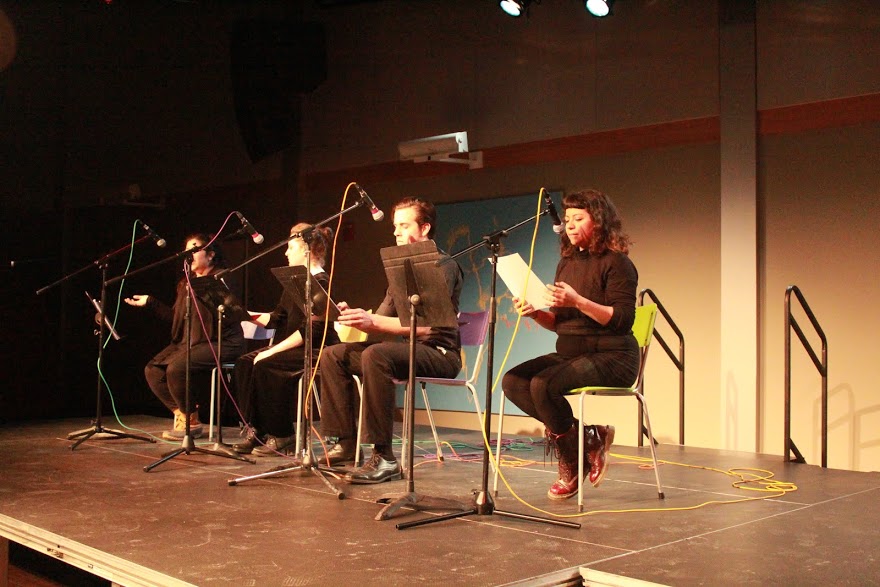
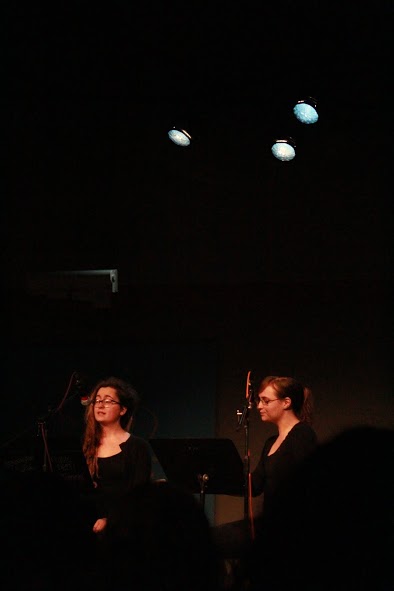
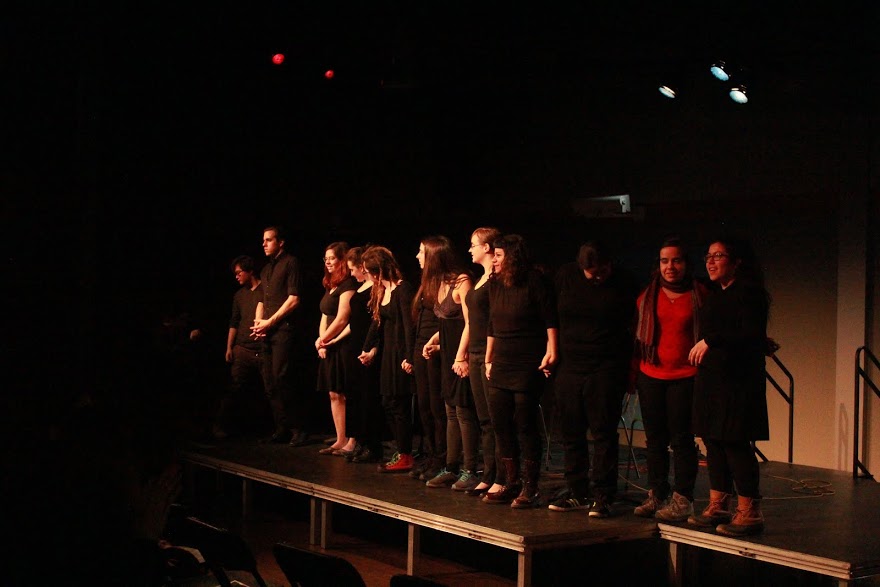
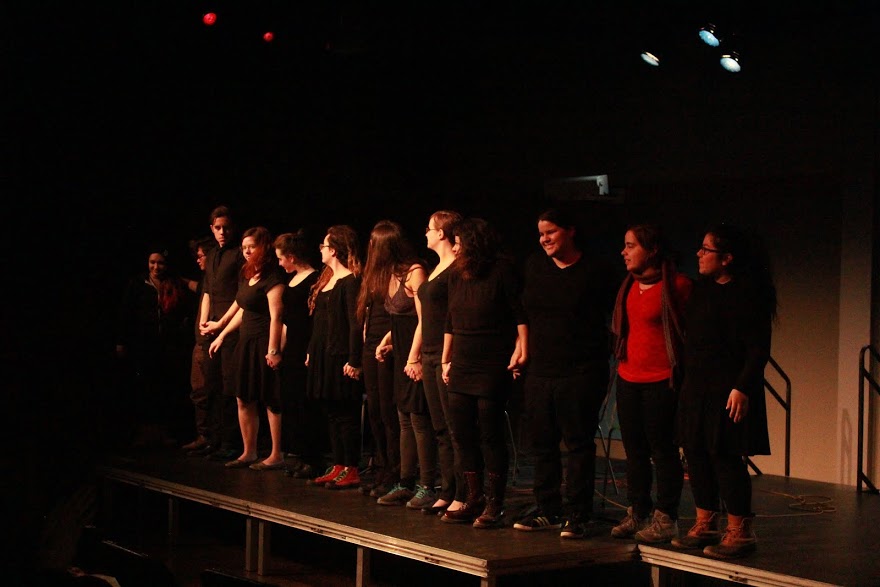
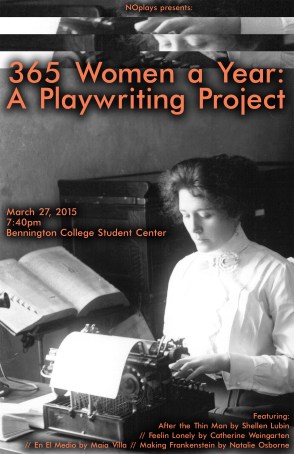
365 Women a Year at Bennington College, our first production, happened this March. We had an excellent turnout both locally with audience members who attended the event live, and an international audience who tuned into the live-stream. We introduced four new works by female playwrights Shellen Lubin, Maia Villa, Catherine Weingarten, and Natalie Osborne. Their plays celebrate the achievements of extraordinary women such as Mary Shelley, Elizabeth Bishop, Stella Adler, Slyvia Gassel, and Gloria Anzaldua.

DSCN0547

LADIES FIRST, a newsletter for new productions, workshops, readings, and publications by female playwrights, launched it’s first two issues this November and December. The goals of LADIES FIRST are to create greater gender parity in theatre by highlighting the works of female writers and the organizations that promote and produce their works.

None of this would be possible without support from our communities, from the many theatre-makers who have given their time and talents to our projects, and from our followers. Thank you for an amazing year, and we hope 2016 will be an even bigger one!

So What’s Next for 2016?

365 Woman a Year is Back!

carnival-300x227

NOplays, in collaboration with Hubbard Hall, will be presenting another production of the 365 Women a Year, Bennington plays. The production will be part of Hubbard Hall’s Winter Carnival this January.

Featuring three returning plays; Making Frankenstein by Natalie Osborne, Feelin’ Lonely by Catherine Weingarten, and After the Thin Man by Shellen Lubin.

The production will also feature one world premiere, Pina by Emma Plotkin.

En El Medio, by Maia Villa, one of the four original 365 Women a Year plays, is currently being workshopped by Chicanas Cholas y Chisme in Los Angeles, and will have a production in March 2016.

The 365 Women a Year performances will take place the evenings of Friday, January 29th and Saturday, January 30th.

Hope to see you there, and have a safe and happy New Year!


365 Women a Year Video

If you missed NOplays first production in collaboration with 365 Women a Year, then you’re in luck! Here’s a video of the event. The reading series took place on March 27th in the Bennington College Student Center and features the work of four new plays by Bennington Students and Alumni. Enjoy!

Special thanks to HowlRound and NiteCorp for making the livestream possible. Be sure to check out videos of the other play reading events that were a part of 365 Women A Year’s first festival in the HowlRound archive.

Interview with Maia Villa

unnamed-1

Maia Villa discusses her new play EN EL MEDIO. This is the last in a series of four posts featuring the playwrights of the Bennington 365 Women a Year Festival.

Q: How did you hear about 365 Women a Year? 

A: My friend and peer Natalie Osborne!

Q: Why did you choose Gloria Anzaldúa as your historic woman? What drew you to her? 

A: As a Chicana theatre artist, I felt a responsibility to represent the Chicana identity, which can be seen as both a curse and a blessing to any artist of color (any artist belonging to any underrepresented group). The decision was not forced,  however, because Gloria deserves so much recognition. Gloria can be described as chicana, tejana, queer, a feminist, a “dyke-feminist” (as said by her), a poet, a writer, a scholar, a cultural theorist, an activist…the list goes on.
Gloria also means a lot to me, personally. Discovering her and her work two years ago in my college’s library (Shout out to Crossett!) relieved me of the stress I used to have when grappling with the complexity of my own identities. Growing up, the identity of “American” and “Mexican” were in constant conflict with one another. She’s the one whose words taught me…haha, essentially, POR QUE NO LOS DOS?! To be Chicano/a means to simultaneously celebrate your American identity with your Mexican heritage…YOU CAN NOT SPEAK SPANISH, AND STILL BE CHICANO/A. Her permission informed my work at Bennington and beyond so much, and continues to today. She’s my identity savior.

Q: Can you walk me through the process of adapting a persons life for the stage? What were some of the challenges? What parts really clicked together? 

A: There were definitely a lot of challenges for me that made this process a long one. I got stuck a lot worrying about whether or not I would be giving Gloria’s life and work the representation it deserves. An example of something I was worried about: Gloria writes in six variations of Spanglish (Tex-Mex Spanish, Chicano English, etc.); so I was sad that, because I am monolingual, I would not be able to write a play that involves what she did with language in her own work.

I had to alleviate the pressure I was putting on myself before the *click* could emerge. I made the decision that, because Gloria’s work is all about inspiring others to break their normative perceptions of identity, I would allow my own grappling with my identity to seep into the work. I would allow me to seep into the work. Once I did that, two characters emerged out of a blend of both Gloria and Maia, and they came out of a time when I was deeply entrapped in my own Maia version of the BORDERLANDS! A personal event (relating to race) made me angry (an emotion I don’t actually feel easily for too long), so I contained the feeling, put myself in an empty theatre space, did a lot of physical actor work, and that was the moment all the *clicks* came together.  I intellectualize race so often with my peers during class, club meetings, etc. that I rarely allow the time to remember that inside me there’s still a little girl who hasn’t intellectualize anything — who simply feels…torn into two pieces, confused about where “home” is supposed to be. Gloria wrote about the Borderlands to put into words that feeling of being Chicano/a — of being neither and both at the same time.

Q: I’m captivated by the way you use language in the play, can you talk to me more about that? 

A: Ha ha, as I wrote earlier, I really just let it emerge. I could probably talk more about the how or why after I’ve done more readings and more revisions of the play. For now, I have ideas about how or why I did this or that, but nothing solidified yet — and I like it that way. All I’ll say is that I let ideas of Gloria’s flow through ideas of Maia and hoped they would come together to mean something for someone else.

Q: Are there any playwrights that inspired you while you were working on this piece, or who inspire you in general? 

A: I don’t consider myself a poet nor even a student of poetry, but I focused on being inspired by Gloria’s words — and also the work of another Chicana writer, Cherrie Moraga. Many, many playwrights inspire me, especially my peers at Bennington.

Q: What has been your favorite aspect of working with 365 Women a Year? 

A: Simply how we were able to create a community of artists nationwide via social media. YUM. I study community development on a smaller scale through my work at Bennington and my work at various non-profit theaters; but haven’t yet explored how community is developed on a bigger scale just yet. It’s exciting to me how we all have joined together without even knowing many of each other’s faces.

Q: Do you have any advice for the playwrights joining 365 Women a Year in 2015? 

A: Don’t feel the pressure to represent someone’s entire life in one piece! Duh. It’s totally okay to take a juicy slice out of their life, or, if you’re like me, write a bunch of slices that represent what they have meant to you.

A recording of the world premier of  EN EL MEDIO at the Bennington College Student Center on March 27th is available here and on the public archive on the HowlRound site.

To see the other post in this series, click on one of the links below:

Catherine Weingarten

Shellen Lubin

Natalie Osborne

Interview with Natalie Osborne

Natalie Headshot

Natalie Osborne discusses her new play MAKING FRANKENSTEIN. This is the third in a series of four posts featuring the playwrights of the Bennington 365 Women a Year Festival.

Q: How did you hear about 365 Women a Year? 

A: I found it on Facebook while I was searching the interwebs one day and signed up immediately! I think this project shows what a great tool social media can be for connecting artists (or anyone really) and allowing them to reach a common goal.

Q: Why did you choose Mary Shelley as your historic woman? What drew you to her? 

A: I’ve actually wanted to write a piece about Mary Shelley for a long time, but I was worried about doing her justice. This chick was still a teenager, and she managed to not only finish a novel, but write a masterpiece, and create an entirely new genre of literature! She had already co-written and published several books with Percy Shelley before writing Frankenstein, which is something I don’t think most people know about. When I first started seriously writing fiction as a teenager, knowing that she had been able to do so much at such a young age became a huge inspiration/motivation for me (it still is)! Writing a play about her, however, was still intimidating.

I had it in my head that there were all these books I had to read and research I had to do before I could start. Then one summer I signed up for 31 Plays in 31 Days, which is similar to NaNoWriMo for playwrights (you have to write one new play every day of the month). By the end of the month, I was running out of ideas, and decided, “sure, why not write that play about Mary Shelley.” That ended up being the first draft of Making Frankenstein.

Q: Can you walk me through the process of adapting a persons life for the stage? What were some of the challenges? What parts really clicked together? 

A: The biggest challenge for me was getting started. I had to let go of the idea that I needed to know absolutely everything about Mary Shelley before I could write. After that, I was able to let myself explore, and the rest of the play came pretty quickly. With this play, I knew I wanted to focus on the night when she wrote the first draft of Frankenstein. I wanted to explore what could have possibly been going through this women’s head when she came up with this idea! I directed most of my research towards the “moment before,” so I could know what place the characters were in the night Frankenstein was born. I don’t want to give away any spoilers, but I will say that Mary and Percy’s relationship was not an easy one, the couple faced more than their fair share of tragedy. Although Mary was still a teenager when she wrote the novel, she had already experience more of life than a person twice her age.

Q: What are you most excited about for the reading on the 27th? What are you most nervous about?

A: I can’t wait to see the play read aloud by actors! I’m really lucky to have four very talented performers in the piece, and I’ve enjoyed working with them. I don’t think I could have asked for a better cast.

That being said, I always feel nervous before a play reading. There’s the question of, did I do enough? Did did I do enough rewrites? Will people understand this? Is it funny enough? And my personal favorite, but what if no one shows up….but what if they DO show up?! It’s nerve-wracking to have worked on a piece and then having to throw it out into the world and see how people react to it.

Q: Are there any playwrights that inspired you while you were working on this piece, or who inspire you in general? 

A: Five Lesbian Brothers, Sarah Ruhl, Carol Churchill, and Lisa D’amore are writers who’s plays I’m currently obsessed with

Q: What has been your favorite aspect of working with 365 Women a Year? 

A: I just love being part of this awesome group of ladies (and gents) and seeing the amazing work that’s come out of this collaboration. We have 200 plus plays written and dozens of productions happening around the world! That’s pretty incredible.

Q: Do you have any advice for the playwrights joining 365 Women a Year in 2015? 

A: WRITE! YOU MUST WRITE! (Ok, so that might have been a little overdramatic, can you tell I do theater?) In all seriousness, you need to take that first step into writing, don’t let the fear of not knowing enough hold you back. I learned a great quote this winter from a fellow playwright, “researching is a great way to procrastinate from writing without feeling like you’re procrastinating.” In other words, don’t do what I did, because it took me years to finally bring myself to put the words on the page. Once I did, I realized I had the story there all along, I just needed to do the work.

Natalie Osborne is a Senior at Bennington College studying Theatre and Anthropology. She likes to tell weird, fun, feminist, queer friendly, and fantastical stories (sometimes all at once). She’s had two readings at Classic Theatre of Harlem in their Playwright’s Playground Program, and has worked with La Mama Theatre in New York City, The Kattaikkuttu Sangam in Punjarasantankal India, and The Athena Project in Denver, Colorado.  She’s now super excited about being involved in this project with all these other fabulous playwright ladies! You can see her play MAKING FRANKENSTEIN at the Bennington College Student Center on March 27th, at 7:40pm. Or watch the online stream on HowlRound TV

To see the other post in this series, click on one of the links below:

Catherine Weingarten

Shellen Lubin

365 Women a Year THIS FRIDAY!

365 Women a Year Poster small Update

This is the week! On March 27th, World Theater Day, we will celebrate the lives of historical women who changed our world, with play-readings from Madrid to New York to Bennington, Vermont.

We hope you will join us at 7:40pm in the Bennington College Student Center, in person or through the livestream on HowlRound TV!

Join our Facebook event!

Interview with Shellen Lubin

10486376_10153092201196564_1097019723351688474_n

Shellen Lubin discusses her new play AFTER THE THIN MAN. This is the second in a series of four posts featuring the playwrights of the Bennington 365 Women a Year Festival.

Interviewer: Natalie Osborne

Q: How did you hear about 365 Women a Year? 

A: On facebook — not even sure whether it was a post in the Playwriting group there — or just noticing one of Jessica’s posts — but I immediately became involved.

Q: Why did you choose Stella Adler and Sylvia Gassell as your historic women? What drew you to them? 

A: I studied with Stella Adler when I was younger, and she was in her 70s. Sylvia Gassell was in a play of mine when she was in her late 60s. Sylvia told me about Stella coming back from Hollywood and telling her not to go out there as a “character actress” because there are no parts for them. It’s something that has stayed with me all these years. I decided to imagine the moment when Stella gave up on acting as a profession and decided to teach, and that decision became the center of this play. (Also the fact that she was right, because, as brilliant as Sylvia was, how much did she really get to work in New York?)

Q: Can you walk me through the process of adapting a persons life for the stage? What were some of the challenges? What parts really clicked together? 

A: I read and read until something about their path excited me, sparked me, and then focused my research on that aspect, fleshing out “information” where I needed it. The biggest challenges are 1) knowing that truth is more important than life, and so you have to write what makes the play work, not worry about what actually “happened”; 2) knowing that whatever you write about them, there is so much more, and the more ground you try to cover the less depth the piece will have.

The clicks were mostly found in the writing itself, the discoveries that come up when you create characters in your mind and set up the scene and discover where it goes. Some of the greatest clicks were: when I discovered why Stella became a teacher, something that she never discussed publicly and I’ve never heard anyone say about her, but I’m sure is true; when I discovered why she set up her classroom the way she did, not just to aggrandize herself.

Q: What are you most excited about for the reading on the 27th? What are you most nervous about?

A: I am excited about seeing where the director and actors take these women–these characters–having nothing but the words I have written in front of them to start from on their expedition. That has only happened a few times in my life (where I got to see the production but was not a part of the process), and it is always somewhat breathtaking.

Nervous? Hmmm … I guess only that maybe I didn’t write what I thought I did, and it doesn’t get where I wanted it to … yet … because there are always re-writes.

Q: Are there any playwrights that inspired you while you were working on this piece, or who inspire you in general? 

A: Lanford Wilson. Secrets. Discoveries. August Wilson. Athol Fugard. And Shakespeare. Keeping things active.

Q: What has been your favorite aspect of working with 365 Women a Year? 

A: I have only once before written a biographical piece, and working on these two pieces has really helped me with that one (still in the middle of re-writes). I have also only written a few short plays. Most of my work has been full-length. It has been very exciting to just pick women I want to write about and then read all about them, become absorbed in their lives, and discover what it is I want to say, the angle I want to come from, how I want to say it.

Q: Do you have any advice for the playwrights joining 365 Women a Year in 2015? 

A: Don’t think you have to decide what you want to write about the person first. Go deep into them and find where they touch you deepest.

And don’t try to cover too much ground. The illumination of one moment or a sequence of a few moments is actually much more interesting than a bio-pic (as it were) of their lives. It’s not a history lesson. It’s a play.

Shellen Lubin is a playwright, songwriter, and director, most recently writing music & lyrics for Susan Merson’s BETWEEN PRETTY PLACES and THE QUALITY OF RESPECT, her take on Shakespeare’s Merchant of Venice. Other produced plays include: IMPERFECT FLOWERS, WAITING, COFFEE ONCE A YEAR, ELEVATOR INVENTIONS. Musicals include: MOLLY’S DAUGHTERS, MY BRAVE FACE, and DEAR ALEX, DEAR HARRIET. She is currently working on the musical WHAT ZEESIE SAW ON DELANCEY STREET (with Elsa Rael and Matthew Gandolfo) and THE SARAH PROJECT. Co-President – Women in the Arts & Media Coalition; Co-Secretary – League of Professional Theatre Women; DG, BMI, SDC, AEA  @shlubin @MonMornQuote. You can see her play AFTER THE THIN MAN at the Bennington College Student Center on March 27th, at 7:40pm. Or watch the online stream on HowlRound TV